
AI agents

Custom AI agents built for one job in your business

Most businesses do not need a general purpose assistant. They need one agent that handles one task properly, every time, using their own data and their own rules.
  • Free first call
  • Written proposal before any work
  • One person to talk to
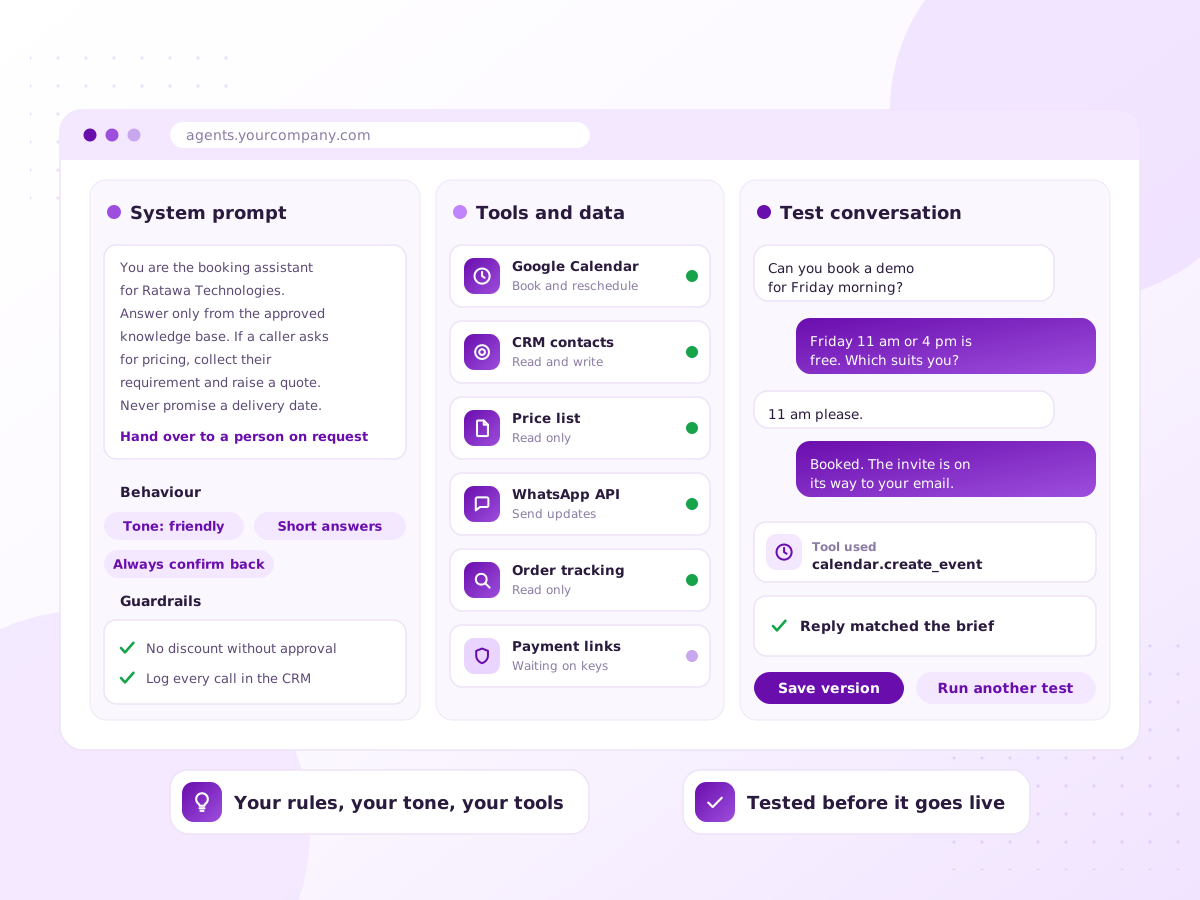
Illustration of an AI agent reading company data and completing a task step by step

Most AI tools talk. An agent finishes the job.

Most AI tools write a paragraph and stop. An agent keeps going: it reads the email, looks up the customer and drafts the quote.

A custom agent does one job. It knows your products, prices and rules, because we feed it your documents.

That narrow focus makes it reliable. It fits work that needs judgement but is too repetitive for a person.

Sound familiar?

The job you keep meaning to hire someone for

The pattern is always the same. Work repeats, follows rules you could write down, and still needs judgement.

  • A task that takes two hours a day
  • Decisions that follow unwritten rules
  • Work that means reading emails, forms and PDFs
  • An automation that breaks on every exception
  • A job you would hire for, but cannot justify
  • Work that happens at 2am or on a Sunday
What’s included

Six parts, and the prompt is only one of them

Anyone can write a prompt in an afternoon. The other five are why it still works in month six.

The reasoning layer

The model that suits the job, plus your rules and worked examples.

Your own knowledge

Your documents and past tickets, indexed so answers come from your material.

Tools the agent can use

A short list of approved actions: look up an order, send a message, create a record.

Guardrails and limits

What it must never do, caps on spend, and a hard stop that passes the job to a person.

Testing on your real cases

We run it on past cases and check its output against what your team did.

Monitoring after launch

Every run is logged: what it did, why, and what it cost.

How it works

From one messy task to an agent you trust

  1. 1

    Pick one task

    A short session to find the task with the clearest rules and the biggest time cost.

  2. 2

    Write the rules down

    How your team does the task, written out. This step alone usually improves it.

  3. 3

    Build and connect

    The agent is built, given its tools and connected to your systems for testing.

  4. 4

    Run it beside your team

    The agent works, a person checks every output, and we fix the mistakes.

  5. 5

    Hand over control

    Once the error rate suits you, review drops to spot checks.

What you get

  • An agent doing one named task end to end
  • The rules and prompts behind it, in your account
  • Connections to your systems, with limited permissions
  • A log of every run and what it cost
  • A review step for anything risky
  • A short handover document

Tools and platforms we work with

Claude API OpenAI API n8n Python LangChain Pinecone or pgvector Supabase Google Workspace

We pick tools that suit your budget and team. If you already use something, we work with it.

Who it’s for

Where agents earn their keep

Professional services

Qualified people losing hours to paperwork.

Operations teams

A daily routine of checking and chasing.

Software companies

Teams wanting an agent inside their own product.

Growing businesses

Owners who need more hands, not another salary.

Why work with Ratawa Technologies

  • You talk to the people building the agent.
  • We say when a simple automation would do instead.
  • A written scope and price before work starts.
  • Prompts, workflows and code stay in your name.

What affects the cost

An agent is priced per build. The main factors:

  • How many steps, and how often exceptions come up
  • How many systems the agent reaches into
  • How much tidying your documents need first
  • Model usage, paid to the provider monthly

You get a fixed written quote after the first call. No surprise charges.

FAQ

Custom AI Agents: common questions

A chatbot talks, an agent acts. It checks the order, raises the refund and emails the customer.
A model can produce confident nonsense, so we design around it. It answers from your documents and says when it does not know. Money goes to a person.
It logs the run, flags it and hands the case to your team. An agent that stops is fine. One that guesses is not.
Usually Claude or GPT, chosen per task. Long documents suit Claude. High volume sorting is cheaper on a smaller model.
No, we almost never fine-tune. The agent reads your documents as it works, so a policy you change today applies today.
A well-defined task usually takes a few weeks. Agents that touch many systems take longer.

Have a task in mind?

Describe one job that eats your team’s week. We will say whether an agent is the right answer.