AI automation

AI inside the software you already run

You do not have to replace anything. Most of the value comes from adding a few well-chosen AI features to the systems your team already lives in, through their APIs.
  • Free first call
  • Written proposal before any work
  • One person to talk to
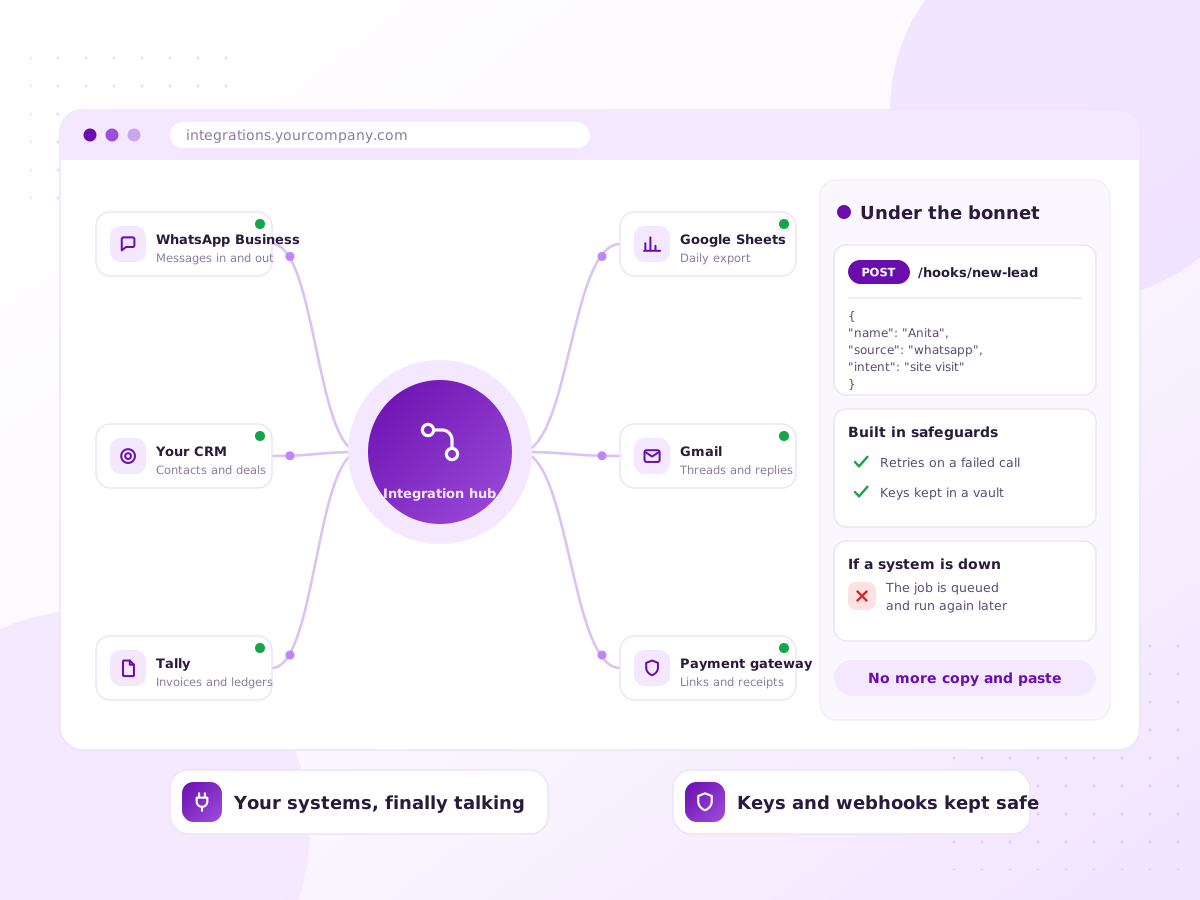
Illustration of an AI model connected by API to a CRM, a website and an internal system

Someone in your office is already pasting into ChatGPT

They have a second tab open right now, dropping in a customer message and copying the answer back. That is the feature you are missing, done by hand.

An integration puts the model where your team already works: a summary button in your internal tool, automatic sorting of records, a search box that understands a question.

The model is the easy part. The work is authenticating safely, handling a slow API, keeping costs predictable and failing gracefully.

Sound familiar?

Where teams usually get stuck

Each of these is an ordinary place to start, and none means replacing the software you run.

  • You want an AI feature inside your own product
  • Your team copies text into ChatGPT and pastes it back
  • Search in your system only matches exact words
  • Records arrive unstructured and get sorted by hand
  • A proof of concept works but nobody will ship it
  • AI costs are unpredictable and nobody is watching
What’s included

Production work, not a demo

A prototype impresses a meeting. These are the parts that keep it standing once real users arrive.

Model API integration

Claude, OpenAI, Gemini or an open model connected to your app, with usage tracked.

Search over your own data

Retrieval across your documents, so answers come from your content with the source shown.

In-product AI features

Summaries, drafting, classification and extraction inside the interface users already use.

APIs and MCP servers

A controlled way for assistants to read your data and trigger actions.

Cost control

Per-feature budgets, caching, and alerts before a bill surprises you.

Safety and fallbacks

Rate limits, timeouts, retries and sensible behaviour when the model is down.

How it works

One feature, built beside your developers

  1. 1

    Scope the feature

    One feature, defined precisely, with what good output looks like written down first.

  2. 2

    Check feasibility honestly

    A short spike against your real data. If the quality is not there, you hear it early.

  3. 3

    Build behind a flag

    The feature can be switched off instantly without touching the rest of the system.

  4. 4

    Evaluate on real cases

    Outputs scored against examples you provide, so quality is measured rather than felt.

  5. 5

    Ship and watch

    Released to a small group first, with usage, latency and cost monitored.

What you get

  • A working AI feature inside your existing system
  • API keys and accounts in your organisation’s name
  • Cost monitoring and per-feature spending limits
  • Fallback behaviour when the model is slow or down
  • An evaluation set so future changes can be tested
  • Technical documentation for your own developers

Tools and platforms we work with

Claude API OpenAI API Google Gemini Model Context Protocol Python Node.js Laravel pgvector

We pick tools that suit your budget and team. If you already use something, we work with it.

Who it’s for

Teams with software worth keeping

Software companies

Product teams adding AI without pausing the roadmap.

In-house development teams

Teams who want a specialist alongside them for the first feature.

Companies with their own systems

Businesses running an ERP or portal nobody else will touch.

Regulated businesses

Organisations needing audit trails and strict data boundaries.

Why work with Ratawa Technologies

  • We work inside your codebase and your conventions, not around them.
  • Quality is measured against real examples before anything ships.
  • If the quality is not there, we say so and you do not build it.
  • Keys, accounts and code stay with your organisation.

What affects the cost

Quoted per feature, or as a block of development time. It depends on:

  • How many features, and how deep they reach
  • The state of your existing codebase and its APIs
  • Whether data needs preparing and indexing first
  • Model usage, paid to the provider by volume

You get a fixed written quote after the first call. No surprise charges.

FAQ

AI Integrations & APIs: common questions

It depends on the task, and it is worth testing rather than assuming. We benchmark two or three on your real data and show you the difference.
Not on the business API plans we use. If your data cannot leave your network, we can run an open model on your own infrastructure.
Per-feature budgets, hard caps, caching, and a smaller model where it performs the same. You see spend per feature.
Then we tell you and you do not build it. Saying so early is cheaper than a feature nobody trusts.
Yes, and that is often best. We build the first feature alongside your team and document the patterns.
It is a standard way to let an assistant use your data and tools with scoped permissions. Otherwise a plain API is fine.

Got a system you want AI inside?

Tell us what the software does and what you want it to do. We will say if it is feasible and what the first feature would take.